
Sagging and coming loose · Omaha, NE
Gutter Hangers, Straps and Spikes
Everything holding your gutter up is a handful of fasteners in a wooden board. How they were fitted decides how long the run lasts.
The short answer
Modern gutters hang on hidden hangers clipped inside the trough and screwed into the fascia. Older installs used long spikes driven through the gutter. Straps fasten to the roof deck instead, for buildings with no fascia. Spacing matters as much as type.
A gutter full of water is heavy, and the only thing between that weight and the ground is a row of fasteners in a wooden board. Worth knowing what yours are.
Hidden hangers
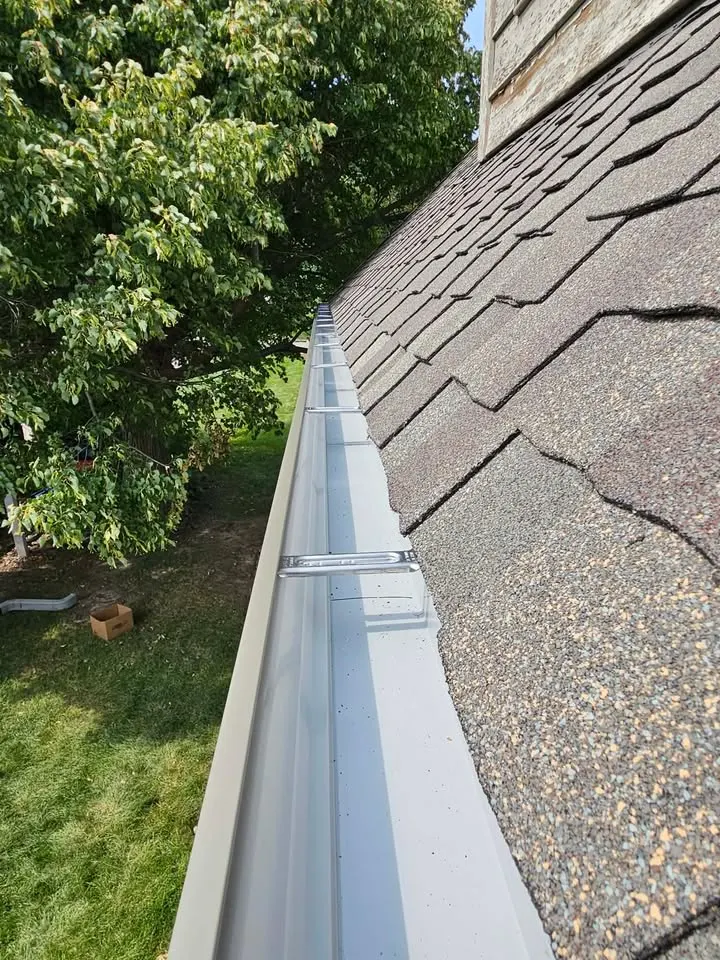
The current standard. A bracket sits inside the trough, clips over the front lip and the back wall, and a screw goes through the back of the gutter into the fascia.
Why they work well:
- They use a screw, not a nail. Screws hold under repeated expansion and contraction. Nails back out.
- They brace the trough’s shape. By gripping both the front lip and the back, they stop the gutter deforming or spreading under load.
- They are invisible from the ground, which is where the name comes from.
Here is a real install with the hanger visible inside the trough:
Spikes and ferrules
The older method. A long spike is driven through the front of the gutter, through a tube called a ferrule that stops the trough being crushed, and into the fascia behind.
The problem is the nail. Metal expands and contracts with every temperature swing, and Omaha gives you plenty. Each cycle works the spike out a fraction. Over years it backs out far enough to lose grip, the front of the gutter drops, and you get the classic look of a run with one spike head standing proud of the face.
If you can see nail heads along the front of your gutter, that is what you have. It is not an emergency, but it explains a lot if the run is sagging.
Straps
Fasten to the roof deck rather than the fascia, running up under the shingle course. Used where there is no fascia board to screw into, or on some commercial roofs.
Because they go under the roofing, the same warranty caution applies as with drip edge and gutter apron: if your roof is under warranty, ask before anyone lifts a shingle.
Spacing is the part people skip
Type matters. Spacing matters as much and gets far less attention.
Every hanger carries a share of the load. Space them widely and each one carries more, and the trough between them has more unsupported length to sag through. A run held by too few hangers will drop eventually even if it is kept spotlessly clean, and it will sag between the hangers rather than at one end.
Tighter spacing is normal in two situations: where snow and ice load is a factor, which includes here, and on long runs.
The common failure is a repair where somebody replaces the fasteners that failed and does not add any. The run goes back up with the same spacing that could not hold it the first time.
The wood is half the system
This is the thing to take away. A hanger is only as good as what it screws into.
The fascia is the board along the roof edge that takes those fasteners. If water has been getting behind the gutter, that board has been staying wet, and wet wood rots. Rotted wood does not hold a screw.
So before adding hangers to a sagging run, check the board. Press a screwdriver gently against the fascia near a fastener. Sound wood resists. Soft wood gives.
If it gives, adding hangers is throwing money at it. The board has to be dealt with first. We handle fascia as part of a gutter replacement, when the run is off and the board is exposed anyway. We are not a standalone fascia or soffit contractor, so if the wood is the whole job, you want a carpenter.
Can you do this yourself
Adding or replacing hidden hangers on an accessible single story run is within reach for most people, provided the fascia is sound and you are comfortable on a ladder. Work from a stable ladder, never lean on the gutter, and put the new hangers at sensible spacing rather than only replacing what failed.
What is not a DIY job: anything on a second story, anything where the fascia is soft, and anything involving working under the shingle course.
What we do
We re-hang and re-secure runs as repair work, and we check the fascia before fastening anything to it rather than after. Every installation carries a 1 year written warranty covering leaks and any area of the gutter that fails from how it was installed.
Estimates are free, with a $250 minimum on any job.
Related gutter problems
See every gutter problem we cover Gutter Repair Gutter Installation
Want somebody to actually look at it?
Free estimate, no pressure, and a straight answer on whether it is a small fix or a bigger job. $250 minimum on any job. Serving Omaha and the surrounding metro.