
Cleaning and timing · Omaha, NE
How Often Gutters Actually Need Cleaning
Twice a year is the standard answer. It is also wrong for a lot of houses, in both directions.
The short answer
Twice a year is the usual advice: once in late autumn after the leaves drop, once in spring. But the honest number depends on your trees and your roof, and ranges from once a year on an open lot to four times on a house under mature trees.
Search this and you get “twice a year” everywhere. It is a reasonable default and it is wrong for plenty of houses, which is worth knowing before you either waste money or wreck a gutter.
Why twice a year became the answer
The two cleanings in the standard advice are doing different jobs.
Late autumn, after the leaves are down. This is the one that matters most, and the timing is the whole point. Cleaning in early October while the trees are still dropping means doing it again in November. Wait until the drop is genuinely finished.
Spring. Clears what blew in over winter, plus the seeds, buds and catkins that come down in spring, which people forget about entirely. It also lets you see what winter did to the gutters while the weather is decent enough to fix it.
The autumn one is not optional here
If you only do one, do the autumn one, and this is the Nebraska specific reason.
A trough packed with wet leaves going into the freeze holds water that cannot drain. That water freezes, expands, and works the hangers loose from the fascia. Then it thaws, then it freezes again. Omaha crosses freezing repeatedly through the season rather than freezing once in December and thawing in March, so that cycle runs many times.
That repetition is what splits seams, deforms troughs, and pulls gutters away from houses in this metro. It is not one cold night. It is the cycling, and it acts on whatever water your gutter was holding when winter started.
Going into the freeze with a clear trough and a clear downspout is the single most useful piece of gutter maintenance there is here.
What actually sets your number
Your trees, and which kind.
- No trees over the roof, open lot: once a year is often genuinely enough.
- Mature deciduous trees nearby: twice.
- Trees directly overhanging the roof: three times, sometimes four.
- Pines: more often than you would think. Needles drop year round rather than in one autumn burst, they are small enough to pack tight, and they mat together.
Your roof’s age. This is the one people miss. Asphalt shingles shed mineral granules for their whole life, and a newer roof sheds fastest as it weathers in. A house with no trees at all can still fill a gutter with grit.
Here is what that actually looks like, from a real removed section:
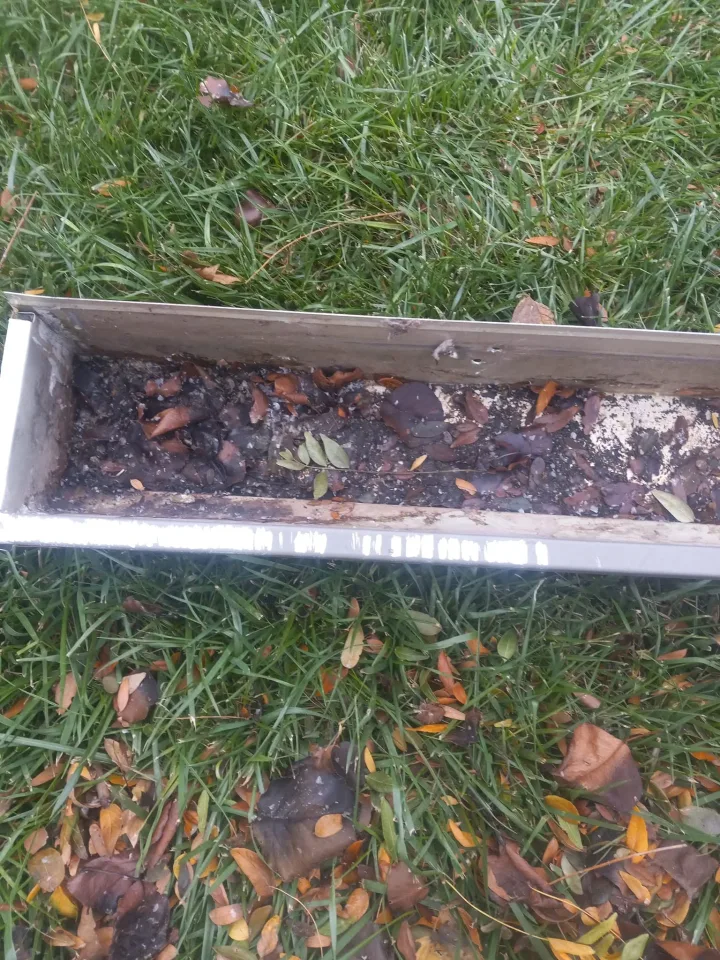
That black sludge is what leaves and roof grit become after a season of sitting wet. It does not blow out and it does not rinse away.
Your roof’s pitch. Steep roofs shed debris more readily. Low pitched roofs hold it, and more of it ends up in the trough.
How to find your own number
Stop guessing after the first year:
- Clean in late autumn, after the drop finishes.
- Check in spring. Note roughly how full it is.
- Nearly empty? Once a year is fine. Half full? Stay at twice. Packed by spring? You need a third, probably mid autumn.
Two seasons of this and you know your house, which beats any general rule on the internet.
Signs you have left it too long
- Water coming over the front lip in rain.
- Plants growing in the trough, which means enough soil has built up to support them.
- Staining or streaks down the outside of the gutter.
- Birds or wasps nesting in it.
- A visible sag, which means it is holding standing water and debris and is now heavy enough to pull.
- Water running down the wall rather than through the downspout.
Guards change the number, they do not remove it
Guards cut how often the trough needs clearing, usually to about once a year rather than two or three times. Fine material like roof grit and pine needles still works through any opening over time. Anyone telling you a guard means never cleaning again is overselling, and that includes the guard we install ourselves.
If you would rather not do it
We clean gutters as a standalone job, not just alongside an install. We clear the downspouts as well as the trough and check that water runs all the way through before calling it done.
Estimates are free, with a $250 minimum on any job.
Related gutter problems
See every gutter problem we cover Gutter Cleaning Gutter Guards
Want somebody to actually look at it?
Free estimate, no pressure, and a straight answer on whether it is a small fix or a bigger job. $250 minimum on any job. Serving Omaha and the surrounding metro.