
Overflowing and leaking · Omaha, NE
Gutters Overflowing in Heavy Rain
Water sheeting over the front lip during a downpour usually means one of three things, and only one of them is debris.
The short answer
Water pouring over the front edge in heavy rain means the trough cannot move water fast enough. The cause is debris, too little downspout capacity, or a gutter that is undersized or pitched wrong. Clean it first, because that is free to check.
A gutter is a pipe laid on its side. It has a fixed capacity, and once rain arrives faster than that capacity, the extra water goes over the front lip. That is all an overflow is. The useful question is which of three things is eating your capacity.
1. Debris, which is the cheap answer
Check this first because it costs nothing to look. A trough packed with wet leaves and roof grit has lost most of its cross section, and what is left fills instantly in a hard rain.
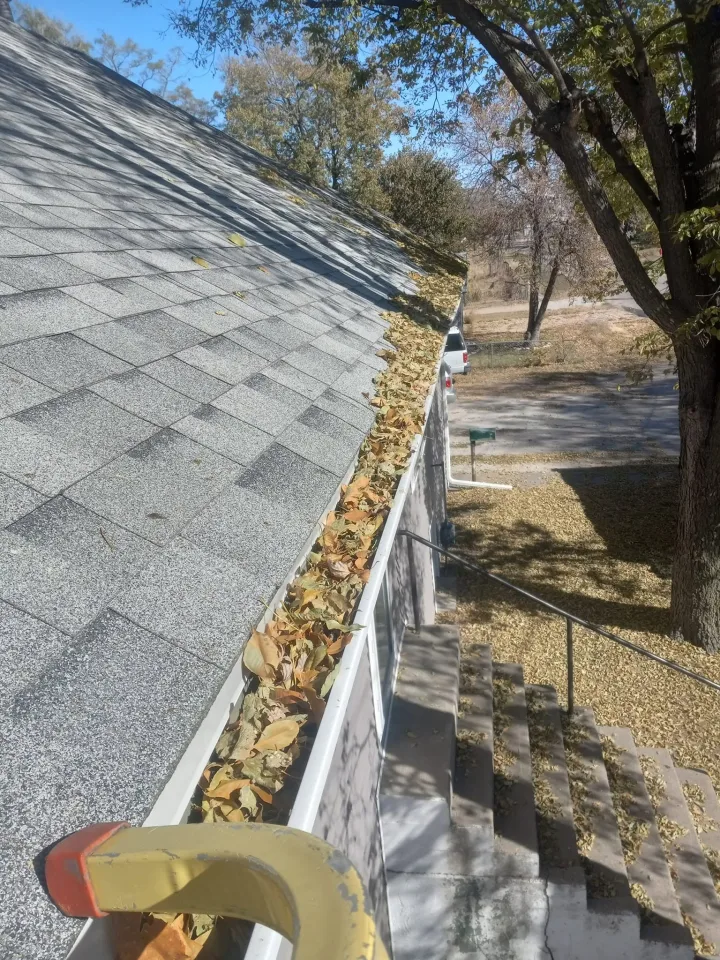
That is a real Omaha roofline, not a stock photo. Note that the leaves are packed the full length of the run, not piled at one end. If yours looks like that, clean it and watch the next storm before spending another dollar.
The tell that it is debris: the overflow happens at a specific spot, usually near a corner or above the downspout, and it got worse gradually over a season.
2. Not enough downspout
This is the one most people never check. The trough carries water sideways, but the downspout is the only way out. Too few downspouts, or one that is partly blocked, and the trough backs up no matter how clean it is.
A long run with a single downspout at one end is asking a lot of it. Water has to travel the whole length before it can leave, and in a downpour it simply arrives faster than it drains.
The tell: the overflow is worst at the far end from the downspout, or right at the downspout opening where water is stacking up trying to get in.
3. Undersized or pitched wrong
Sizing is measured in drainage area, meaning how much roof the system can handle. This Old House’s sizing guide puts a 5 inch K style trough at about 5,520 square feet and a 6 inch at about 7,960, so roughly 44 percent more roof for one extra inch of width. On a big or steep roof, 5 inch can simply be the wrong tool, and steep roofs also throw water at the gutter fast enough that some of it overshoots the trough entirely.
The bigger lever is the downspout. A 2x3 outlet is rated for about 600 square feet, a 3x4 for about 1,200. Going from 2x3 to 3x4 doubles the drainage at that outlet, which is a larger jump than the gutter width gives you. Our 5 inch versus 6 inch guide works through the whole calculation, and you can see the decision made on a real job in our Phillips garage build, where a 5 inch trough went on with 3x4 downspouts.
Pitch matters just as much. A gutter needs a slight, consistent fall toward the downspout. Too flat and water sits. Too much and it races past the outlet. Hung unevenly and you get a low spot that overflows every time while the rest of the run looks fine.
The tell: it is a newer roof or a recent install, it has overflowed since day one, and the gutter looks clean when you check it.
What Omaha adds to this
Two local factors matter here.
The first is that the metro gets its rain in bursts. A slow all day drizzle rarely overflows anything. The storms that overwhelm a gutter are the short violent ones, which is why people notice this problem two or three times a year rather than constantly.
The second is what an overflow does to the ground. Much of the metro drains into the Papillion Creek watershed, but the part that matters to you is the few feet closest to the house. Water dumping straight down at the foundation, storm after storm, is how a gutter problem turns into a basement problem.
How to work out which one you have
In order, because each step is cheaper than the next:
- Look in the trough. Packed with debris? Clean it, then wait for a real rain and watch.
- Count your downspouts. One downspout serving a long run is a common shortfall.
- Watch during a storm. Where exactly does it come over? Far end from the downspout, one low spot, or everywhere at once? Everywhere at once on a clean gutter points at sizing.
- Check the roof. A big steep roof feeding a 5 inch trough is a mismatch you cannot clean your way out of.
What we would actually do
We would come look at the roofline before quoting anything, because the fix is completely different depending on the answer. If it is debris, that is a cleaning. If it is capacity, we form seamless 5 inch and 6 inch K style on site in over 20 colors, so stepping a run up in size or adding a downspout does not leave you with mismatched metal.
Estimates are free. There is a $250 minimum on any job, which covers getting a crew and equipment out, so if what you need falls under that we will say so before scheduling rather than after.
Related gutter problems
See every gutter problem we cover Gutter Cleaning Gutter Installation
Want somebody to actually look at it?
Free estimate, no pressure, and a straight answer on whether it is a small fix or a bigger job. $250 minimum on any job. Serving Omaha and the surrounding metro.